
Large Blue
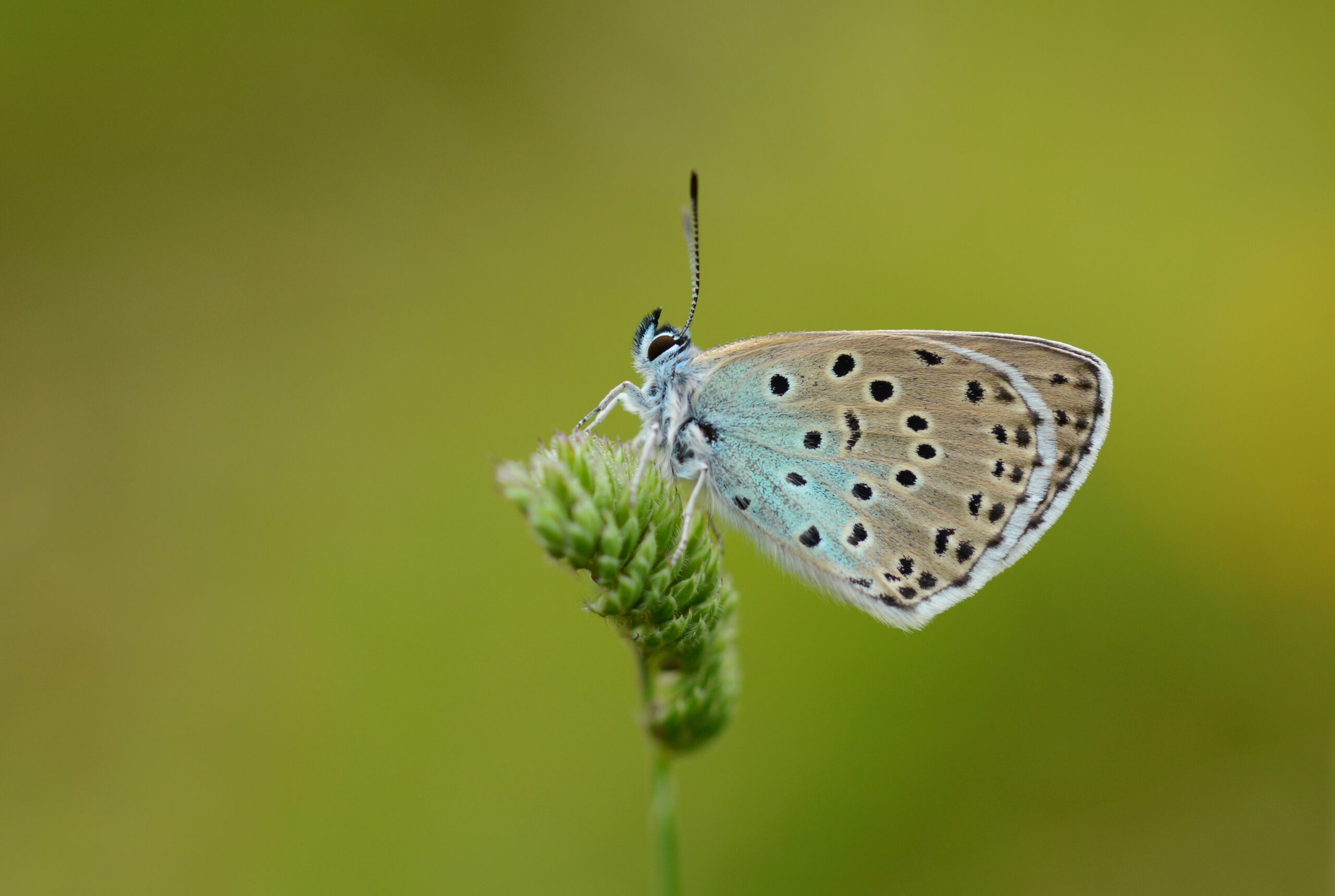
Phengaris arionThe Large Blue is the UK’s largest and rarest blue butterfly, known for its striking blue wings with dark borders and spots. Their lifecycle is equally as extraordinary. After feeding on Wild Thyme, their caterpillars are adopted by ants and taken underground, where they feed on ant grubs before clawing out to the surface as adults. In 1979, they were declared extinct in the UK but they have now been successfully reintroduced and are found in parts of south-west England. Despite this success, they remain globally endangered.

Beautiful, but deadly (to ant grubs)
The Large Blue is, as the name suggests, the UK’s largest of the blue family, and also the rarest.
Once they’ve filled up on their favourite herbs, Large Blue caterpillars will head to the ground and produce drops of liquid from their honey gland. This sweet syrup is irresistible to ants, so much so that they will adopt the caterpillar and bring it back to their nest underground.
There is, however, no such thing as a free lunch. Once in the nest, the caterpillar enjoys the protection of the ants while feasting on their grubs. Once it’s eaten enough of its hosts’ offspring, it’ll form its chrysalis, before crawling out through the tunnels to find the sunlight and taking to the skies as a beautiful adult butterfly.
The Large Blue became extinct in the UK in 1979, but a partnership of conservation organisations including Butterfly Conservation was able to reintroduce them. The Large Blue can only be found in south-western England. Despite this, the Large Blue is still considered a globally endangered species.
Find the Large Blue near warm grasslands that haven’t been ploughed, reseeded or heavily fertilised, and where nests of red ants can be found.


Vibes
Each butterfly is scored out of 100 across a set of traits, from how bold and visible it is to how far it travels or how particular it is about where it lives. These scores compare each species with the other butterflies in Britain, helping you see their differences at a glance. Here’s what makes the Large Blue special.
Bright colours, bold patterns, and a love of the spotlight. Some butterflies just can’t help showing off.
Fast, or throwing some seriously impressive moves, these butterflies are in a flutter.
Always on guard, ready to hide or defend - these butterflies have self-preservation down to an art.
It’s ok to be a little… well, weird. These butterflies have been certified with the freak factor.
Like Goldilocks, everything has to be just right for these perfectionists.
Hard to spot and even harder to forget, these butterflies are a true one of a kind.
Bold, curious, and ready to explore, these brave butterflies live for the thrill and aren’t afraid to travel.
Weather-resistant, battle-hardened, and built to survive, these butterflies know how to take it on the wing.
Chosen By

I’m voting for the Large Blue. I’m so lucky that they’re on my doorstep, and they’re not just a brilliant and vibrant butterfly, they’re also an incredible comeback story. Large Blue went extinct in the UK but now the reintroduced populations are thriving, and it’s a real testament the hard work of everyone involved and the difference that conservation work can make. Plus, they have the weirdest lifecycle! The sneaky little caterpillars trick ants into taking them into their nests underground where they then feast on ant grubs, get nice and fat and sassy, sleep for a bit and them emerge the following year as a butterfly – I love it!
Large Blues trick ants into adopting them, then feast on ant grubs underground before emerging as butterflies.
Test your knowledge
What makes the Large Blue’s lifecycle unusual?Large Blue caterpillars are taken into ant nests, where they live and feed before becoming butterflies.


Voting has now closed